|
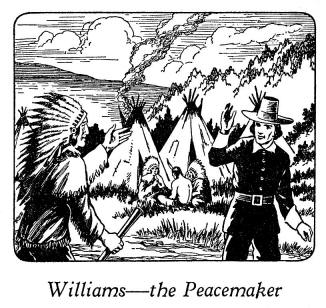
Roger Williams: The Peacemaker
Roger Williams was not only a pioneer in religious liberty ideals and principles far in advance of his time, but he was unexcelled in his day as a peacemaker. He lived in stormy times, and the settlers in New England were in constant danger of attack from the savage Indians, as well as from jealous and rival factions of white men. He not only served as an efficient peacemaker between the various factions whose political aggrandizements threatened to destroy each other, but he was able to calm the ferocity of rival Indian tribes against each other as well as against his enemy, the Massachusetts Bay Colony, on whose destruction the Indians had determined. Roger Williams had a pleasing personality and the happy faculty of bringing order out of chaos. After he left on his second trip to England to make the charter of Rhode Island more secure against Puritan encroachment from Massachusetts than it was as it was first drawn, some heated jealousies sprang up between the various plantations of Rhode Island. Roger Williams induced his old friend, Sir Henry Vane, to write a letter addressed to the inhabitants of the colony of Rhode Island, deprecating the divisions among them, "the headiness, tumults, disorders, injustice," "the noise [of which] echoes into the ears of all, as well friends as enemies, by every return of ships" from New England. He pleaded with them "Is not the love of Christ in you, to fill you with yearning bowels, one towards another, and constrain you not to live to yourselves, but to Him that died for you, yea, and is risen again? Are there no wise men amongst you? No public self-denying spirits, that at least, upon the grounds of common safety, equity, and prudence, can find out some way or means of union and reconciliation for you amongst yourselves, before you become a prey to common enemies?" He further suggested that they choose "commissioners agreed on and appointed in all parts, and on behalf of all interests," to effect, "in a general meeting," such a union and common satisfaction as might put a stop to their growing "breaches and distractions," silence their enemies, encourage their friends, honor the name of God, and refresh and revive his sad heart, their affectionate friend Roger Williams. When Roger Williams finally returned from England in August, 1654, he found the various towns and plantations so hopelessly divided and in civil strife with one another that it taxed his skill and ingenuity to the utmost to effect a reconciliation between the warring factions. He addressed a strong appeal to his "well-beloved friends and neighbors," which not only reflects the utter confusion, the jealousies, and the petty and senseless wrangling of the townsmen, but also reveals his unexcelled qualities as a leader and peacemaker. He told them how he had "spent almost five years with the state of England, to keep off the rage of the English against us," and how he had labored incessantly "to keep up the name of a people, a free people, not enslaved to the bondages and iron yokes of the great oppressions of the English and barbarians about us," and all the reward he had obtained for this service was "grief and sorrow and bitterness." He further stated, "I have been charged with folly for that freedom and liberty which I have always stood for; I say, liberty and equality, both in land and government.... But, gentlemen, blessed be God who faileth not, and blessed be His name for His wonderful providences, by which alone this town and colony, and that grand cause of truth and freedom of conscience, hath been upheld to this day." The deputies of the different plantations had refused to come to the general assembly in Providence or to meet together in conference to iron out their differences, and their union was on the point of dissolution and likely to be swallowed up by the Massachusetts Bay Colony. Roger Williams displayed his qualities as a leader of opposing factions at this critical moment, and took personal responsibility in effecting peace and harmony. He promised all deputies of every faction, if they came together to consider "the common peace, and common safety, and common credit," and were willing to sacrifice something for the cause of "pacification" and "for a union" of the plantations, that all should have the right of "free debate and conference" and the right to "vote in all matters with us" of the plantations. This appeal had its inevitable effect, and prepared the way for the reconvening of the General Assembly in Providence and the reconciling of all their differences, and led not only to the reestablishment of the union, but to the making of the Union of the Providence Plantations more democratic. At a general election held on September 12, 1654, Roger Williams was elected president of the Republic of the Providence Plantations. Though this choice of the people of Rhode Island was quite contrary to his own choice and wish, yet the public need and demand, as in the case of George Washington in his election to the first Presidency of the Republic of the United States, made his acceptance of the office inevitable. The General Assembly, which ratified the election of Roger Williams as president, authorized him to write a letter of thanks to His Highness the Lord Protector, Oliver Cromwell, and to Sir Henry Vane and other friends in England, in the name of the republic of the Providence Plantations, and that Mr. Roger Williams subscribe his name "with the title of his office." The people of Rhode Island were proud of the new form of their government, and they were proud of their first president, who had set up a model republic, as a pattern for others to follow, with the church and state completely separated, with the conscience of the individual unfettered in religious matters, with the franchise granted to all citizens, with freedom of the press and of speech granted to all men, and with rulers and lawmakers selected only by the consent of the governed. In writing this letter of "humble thanksgiving" to Sir Henry Vane, the first president of this miniature republic in America referred with gratitude to "the many providences of the Most High, toward this town of Providence, and this Providence Colony," and to the many letters Sir Henry Vane had directed to the inhabitants of Rhode Island who had been "an outcast and despised people. From the first beginning of this Providence Colony (occasioned by the banishment of some in this place from the Massachusetts) we say, ever since, to this very day, we have reaped the sweet fruits He continued to express his gratitude for their deliverance from the oppressions and persecutions under which the people of Europe were still suffering and for the great liberties which they were now enjoying, saying: "We have long drunk of the cup of as great liberties as any people that we can hear of under the whole heaven. We have not only been long free . . . from the iron yoke of wolfish bishops, and their popish ceremonies (against whose cruel oppressions God raised up your noble spirit in Parliament), but we have sitten quiet and dry from the streams of blood spilt by that war in our native country. We have not felt the new chains of the Presbyterian tyrants, nor in this colony have we been consumed with the overzealous fire of the (so-called) godly Christian magistrates. "Sir, we have not known what an excise means; we have almost forgotten what tithes are, yea, or taxes either, to church or commonwealth. We could name other special privileges, ingredients of our, sweet cup, which your great wisdom knows to be very powerful ... to render the best of men wanton and forgetful.... We hope you shall no more complain of the saddening of your loving heart by the men of Providence Town or Providence Colony, but that when we are gone and rotten, our posterity and children after us shall read in our town records your pious and favorable letters, and loving-kindness to us, and this our answer and real endeavor after peace and righteousness." But no sooner had Roger Williams settled peaceably the internal dissensions of the Providence Colony than his ingenuity was taxed to the utmost to placate and pacify the external threatenings of another Indian war proposed by Massachusetts against the Narragansets. As peacemaker he bestirred himself to prevent the conflict. He reminded the General Court of Massachusetts, which proposed another war against the Narraganset Indians, that in the Pequot wars he was appointed by their government to the hazardous and weighty service and mission of negotiating a league of peace between themselves and the Narragansets, to the imminent danger of his own life at the hands of the Pequot messengers in the Narraganset camp; and that when he had succeeded in arbitrating their differences and effecting a league of peace, their government had been pleased to send him a copy of the league, subscribed by all hands there; and that "since that time in all their great transactions of war and peace between the English and the natives, he had not spared purse, nor pains, nor hazards, very many times, that the whole land might sleep in peace securely;" and that he would not be doing his duty to the Parliament of England, the Council of State, and His Highness the Protector, if he should be silent, when their mutual interests were "not a little concerned in the peace or war" of New England, and since "among their other favors to the colony of Providence Plantations, some were expressly concerning these very Narraganset Indians, the native inhabitants of this jurisdiction." While Roger Williams worked for peace by means of arbitration, yet he was not a pacifist who would never justify the use of the sword. He earnestly declared to the General Court of Massachusetts that he was "never against the righteous use of the civil sword of men or nations, but yet, since all men of prudence, ply to windward to maintain their wars to be defensive," then he earnestly pleaded with his Massachusetts brethren "to live and die in peace with all the natives of New England." "Secondly," he wrote, "are not all the English of this land, generally, a persecuted people from their native soil? And hath not the God of peace and Father of mercies made these natives more friendly in this, than our native countrymen in our own land, to us? Have they not entered leagues of love, and to this day continued peaceable commerce with us? Are not our families grown up in peace among them? Upon which I humbly ask, How can it suit with Christian ingenuity to take hold of some seeming occasions for their destruction, which, though the heads be only aimed at, yet all experience tells us, falls on the body and the innocent?" Again Roger Williams succeeded, as he had upon numerous occasions before, in averting a general war with the Narragansets. He was the peacemaker of New England. Through his indefatigable efforts of charity, he reconciled his enemies with their enemies. The charity he possessed was the charity of Christ, which led him to forgive his enemies as Christ forgave His. At the risk of his own life he saved Puritan and Pilgrim alike from impending Indian massacres, even though they had exiled him to the wilderness and suffering. His spirit of love and liberty for all men, irrespective of their divergent beliefs, enabled him to win men to his standard and to form an enduring compact binding men together in the bond of political union "only in civil things." These United States are the fruition of his hopes, his faith, his ideals, and his labors. All honor to the ideals, the faith, the hope, and the charity of Roger Williams; but the greatest of those was his charity for his enemies, even though they did not appreciate his efforts. THE PRESENT CRISIS Once to every man and nation comes the moment to decide, In the strife of truth with falsehood, for the good or evil side; Some great cause, God’s new Messiah, offering each the bloom or blight, Parts the goats upon the left hand, and the sheep upon the right, And the choice goes by forever ‘twixt that darkness and that light.
Then to side with truth is noble when we share her wretched crust, Ere her cause bring fame and profit, and ‘tis prosperous to be just; Then it is the brave man chooses, while the coward stands aside, Doubting in his abject spirit, till his Lord is crucified, And the multitude make virtue of the faith they had denied.
For Humanity sweeps onward: where today the martyr stands, On the morrow crouches Judas with the silver in his hands; Far in front the cross stands ready and the crackling fagots burn, While the hooting mob of yesterday in silent awe return To glean up the scattered ashes into history’s golden urn.
New occasions teach new duties; time makes ancient good uncouth ; They must upward still, and onward, who would keep abreast of truth ; Lo, before us gleam her campfires ! we ourselves must Pilgrims be, Launch our Mayflower, and steer boldly through the desperate winter sea, Nor attempt the future’s portal with the past’s blood-rusted key. -James Russell Lowell.
|