|
7a. The Controversy and Debate Between Roger Williams and John Cotton
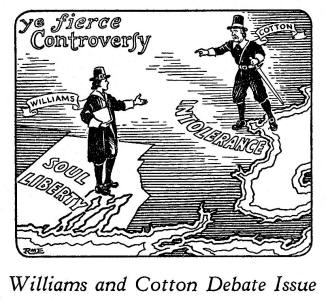
John Cotton, the son of a Puritan lawyer, was destined to become the chief antagonist of Roger Williams in the struggle over liberty of conscience in America. Mr. Cotton had been educated at Cambridge, and in his theological studies he accepted in all their fullness the theocratic principles of John Calvin, the great Genevan Reformer, Upon his arrival in Boston, he was at once called upon to direct and arrange the civil and ecclesiastical affairs of the Massachusetts Bay Colony. He at once drew up a system of laws based upon the civil and religious polity of the theocracy as established by Moses for ancient Israel. John Cotton believed in and strongly advocated the death sentence for so-called "heretics" and for those who "seduced" souls away from the Lord their God, and to John Cotton this meant to seduce souls away from the Puritan faith. As a specimen of John Cotton’s teaching upon this point, we give the following: "If men be found to walk in the way of the wicked (i.e., to differ from the prevailing ‘church’), their brethren may deprive them in some cases, not only of the common air of the country by banishment, but even of the common air of the world by death, and yet (!) hope to live with them eternally in the heavens. It cannot be truly said that the Lord Jesus never appointed the civil sword for a remedy in such cases (heresy), for He did expressly appoint it in the Old Testament, nor did He abrogate it in the New Testament. The reason of the law, which is the life of the law, is of eternal force and equity in all ages. Deut. 13:9. ‘Thou shalt surely kill him because he has sought to thrust thee away from the Lord thy God.’ The reason is of moral, therefore of universal and perpetual, equity, to put to death the apostates, seducing idolater or heretic who seeketh to thrust away the souls of the people from the Lord their God." "Religious Liberty and the Baptists," pp. 33, 34. This was Cotton’s argument for killing heretics and seducers of souls who led people away from the prevailing, or state, church in his day. It is the same sophistry that has been employed by all heretic hunters in all ages. It was the identical argument which was advanced by the Jewish rulers and hierarchy in the days of old, against Christ Himself, and under it they secured His condemnation to death upon the cross. By the same sophistry all the apostles, with the exception of one, were condemned to die the death of heretics and seducers. It was the same argument and sophistry which decreed the death of millions of Christians in medieval times when the church and the state were united in unholy alliance. It was this bloody history that grew out of such unchristian, unholy, and unjust alliances as the result of this sophistry employed by John Cotton which led Roger Williams to expose the fallacious reasonings of Mr. Cotton, and to demonstrate through his own experiment in Rhode Island that civil government prospered and religion advanced much more rapidly when both were completely separated, and all its citizens enjoyed equal liberty of conscience, than under the old order of things. Roger Williams took direct issue with a theocratic form of government established merely by men without a direct authority from God, and as soon as he set his foot upon American soil in Boston, he voiced his opinion that "the magistrate might not punish a breach of the Sabbath, nor any other offence," which constituted "a breach of the first table" of the decalogue. All religious laws enforced by the civil magistrate were abhorrent to the soul of Roger Williams. He was willing to give all due submission to the civil government and to the authority of the civil magistracy in "all things civil." He applied, as soon as he arrived in Boston, to be made a freeman. On the very day on which Mr. Williams entered his application to become an American citizen and a "freeman," the General Court of Boston, as if to challenge a conflict at the earliest moment with Roger Williams, "ordered and agreed, that for the time to come, no man shall be admitted to the freedom of this body politic, but such as are members of some of the churches within the limits of the same." The clergy publicly and earnestly urged and persuaded their church members to give land to none but such as might be fit for church members: yea, not to receive such English into the town." A full-fledged theocracy was set up, and for Puritans only. They hoped to set up the kingdom of God in America and give it to the saints only, and only those saints who agreed with them in both civil and religious matters. Only those were allowed to exercise the franchise. Mr. Cotton contended that " ‘to erect such a government of the church as is most agreeable to the Word,’" or in harmony with the Mosaic theocracy, was well pleasing in the sight of God. It was not long before laws were enacted to banish all who refused to conform and comply "with the state religion." In 1644 a law was promulgated against the Baptists, by which "it is ordered and agreed, that if any person or persons, within this jurisdiction shall either openly condemn or oppose the baptizing of infants," or "seduce others or leave the congregation during the administration of the rite," they "shall be sentenced to banishment." This same year, the magistrate at the instigation of the Puritan clergy caused a poor man to be pilloried and whipped for "refusing to have his child sprinkled." Others were expatriated, and some hanged, on the charges of "heresy" and "blasphemy" because they openly expressed religious opinions contrary to those of John Cotton, the sponsor and monitor of "morals" and "religious convictions." It was this theocratic system of government, wrought out and fathered by John Cotton, that brought Roger Williams into open conflict with this Puritan clergyman, and caused him to write his "Bloudy Tenent" against religious persecution. After Mr. Williams wrote his "Bloudy Tenent," Mr. Cotton entered into an extended debate with Mr. Williams. In this controversy between these two leaders of thought, we find the ideals and principles for which Roger Williams contended fully brought to light, and it is fortunate that history has preserved them for the benefit of American posterity who are lovers of civil and religious liberty and have a desire to preserve their heritage of freedom. This debate between these two champions the one advocating a union of church and state and the other an absolute separation of church and state-is fully set forth in the "Bloudy Tenent" and the "Bloudy Tenent Yet More Bloudy," written by Roger Williams in reply to John Cotton’s theocratic principles of government. Roger Williams ever keeps in the forefront the "sad evil," as he calls it, which grows out "of the civil magistrates dealing in matters of conscience and religion, as also of persecuting and hunting any for any matter merely spiritual and religious," which led to his banishment in New England, and for which he blamed John Cotton. Referring to the state church of New England as well as Old England, Roger Williams said, "I affirm that that church estate, that religion and worship which is commanded, or permitted to be but one in a country, nation, or province, that church is not in the nature of the particular churches of Christ, but in the nature of a national or state church." Mr. Cotton held that "it is not lawful to persecute any for conscience’ sake rightly informed; for in persecuting such, Christ Himself is persecuted in them." To this argument Mr. Williams replied: "To this distinction I dare not subscribe, for then I should everlastingly condemn thousands, and ten thousands, yea, the whole generation of the righteous." "Search all scriptures, histories, records, monuments; consult with all experiences; did ever Pharaoh, Saul, Ahab, Jezebel, scribes and Pharisees, the Jews, Herod, the bloody Neros, Gardiners, Bonners, pope, or devil himself, profess to persecute the Son of God, Jesus as Jesus, Christ as Christ, without a mask or covering? "No, saith Pharaoh, the Israelites are idle, and therefore speak they of sacrificing. David is risen up in a conspiracy against Saul; therefore persecute him. Naboth hath blasphemed God and the king; therefore stone him. Christ is a seducer of the people, a blasphemer against God, and traitor against Caesar; therefore hang Him. Christians are schismatical, factious, heretical; therefore persecute them. The devil hath deluded John Huss; therefore crown him with a paper of devils, and burn him... . "And yet they say, if we had been in the days of our fathers, in Queen Mary’s days, etc., we would never have consented to such persecution. And therefore, when they persecute Christ Jesus in His truths or servants, they say, ‘Do not say you are persecuted for the word, for Christ’s sake: for we hold it not lawful to persecute Jesus Christ.’" Mr. Cotton further contended, "‘It is not lawful to persecute an erroneous and blind conscience, even in fundamental and weighty points, till after admonition once or twice, Titus 3:11, and then such consciences may be persecuted; . . . such a person ... may be persecuted for sinning against his own conscience."‘ Mr. Williams answered, "If persons be willfully and desperately obstinate, after light shining forth, Let them alone, saith the Lord. So spake the Lord once of Ephraim ‘Ephraim is joined to idols, let him alone.’ Hosea 4:17. What more lamentable condition, than when the Lord hath given a poor sinner over as a hopeless patient, incurable, which we are wont to account a sorer affliction, than if a man were torn and racked. The Lord Jesus commands His servants to pass from and let alone, to permit and tolerate, when it is in their power corporally to molest them. "Their end is the ditch, that bottomless pit of everlasting separation from the holy and sweet presence of the Father of lights, goodness, and mercy itself. . . . I answer, the civil magistrate beareth not the sword in vain, but to cut off civil offenses, yea, and the offenders too in case. But what is this to a blind Pharisee, resisting the doctrine of Christ, who haply may be as good a subject, and as peaceable and profitable to the civil state as any: and for his spiritual offense against the Lord Jesus, in denying Him to be the true Christ, he suffereth the vengeance of a dreadful judgment, both present and eternal, as before. . . . But this sentence against him, the Lord Jesus only pronounceth. . . . Such a sentence no civil judge can pass, such a death no civil sword can inflict.. . The great and good Physician, Christ Jesus, the Head of the body, and King of the church, hath not been unfaithful in providing spiritual antidotes and preservatives against the spiritual sickness, sores, weaknesses, dangers, of His church and people. But He never appointed the civil sword for either antidote or remedy. . . . Hence how great is the bondage, the captivity of God’s own people to Babylonish or confused mixtures in worship, and unto worldly and earthly policies to uphold state religions or worships. . . . But as the civil magistrate hath his charge of the bodies and goods of the subject: so have the spiritual officers, governors, and overseers of Christ’s city or kingdom, the charge of their souls, and soul safety." Mr. Cotton replied, " ‘It is a carnal and worldly, and indeed an ungodly imagination, to confine the magistrates’ charge to the bodies and goods of the subject, and to exclude them from the care of their souls.... They may and ought to procure spiritual help to their souls, and to prevent such spiritual evils, as that the prosperity of religion amongst them might advance the prosperity of the civil state.’" Williams answered: "If it be the magistrate’s duty or office, then is he both a temporal and ecclesiastical officer: [the] contrary to which most men will affirm. And yet we know, the policy of our own land and country hath established to the kings and queens thereof the supreme heads or governors of the church of England. "That doctrine and distinction, that a magistrate may punish a heretic civilly, will not here avail; for what is Babel, if this be not, confusedly to punish corporal or civil offenses with spiritual or church censures (the offender not being a member of it), or to punish soul or spiritual offences with corporal or temporal weapons," only "proper to delinquents against the temporal or civil state. ... But, to see all his subjects Christians, to keep such church or Christians in the purity of worship, and see them do their duty, this belongs to the head of the body, Christ Jesus." Mr. Cotton set forth the doctrine that the civil magistrate had a right to deal "‘with men without, as the Samaritans were, and many unconverted Christians . . . who, though carnal, yet were not convinced of the error of their way." Williams answered: "If the civil magistrate be a Christian, a disciple, or follower of the meek Lamb of God, he is bound to be far from destroying the bodies of men for refusing to receive the Lord Jesus Christ: for otherwise" he would "be ignorant of the sweet end of the coming of the Son of man, which was not to destroy the bodies of men, but to save both bodies and souls.... If the civil magistrate being a Christian, gifted, prophesy in the church (I Cor. 14:1), ... yet they are here forbidden to call for fire from heaven, that is, to procure or inflict any corporal judgment, upon such offenders, remembering the end of the Lord Jesus’ coming [was] not to destroy men’s lives, but to save them." "True it is, the sword may make, as once the Lord complained, Isaiah 10, a whole nation of hypocrites; but to recover a soul from Satan by repentance, and to bring them from anti-Christian doctrine or worship to the doctrine or worship Christian in the least true internal or external submission, that only works the all-powerful God, by the sword of His Spirit in the hand of His spiritual officers. "What a most woeful proof hereof have the nations of the earth given in all ages? And to seek no further than our native soil, within a few scores of years, how many wonderful changes in religion hath the whole kingdom made, according to the change of the governors thereof, in the several religions which they themselves embraced! Henry the Seventh finds and leaves the kingdom absolutely popish. Henry the Eighth casts it into a mold half popish, half Protestant. Edward the Sixth brings forth an edition all Protestant. Queen Mary within few years defaceth Edward’s work, and renders the kingdom, after her grandfather Henry the Seventh’s pattern, all popish. Mary’s short life and religion end together; and Elizabeth reviveth her brother Edward’s model, all Protestant... . It hath been England’s sinful shame, to fashion and change their garments and religions with wondrous ease and lightness, as a higher power, a stronger sword hath prevailed; after the ancient pattern of Nebuchadnezzar’s bowing the whole world in one most solemn uniformity of worship to his golden image. Daniel 3." "A carnal weapon or sword of steel may produce a carnal repentance, a show, an outside, a uniformity, through a state or kingdom; but it hath pleased the Father to exalt the Lord Jesus only to be a Prince, armed with power and means sufficient to give repentance to Israel. Acts 5:31. "Accordingly, an unbelieving soul being dead in sin, although he be changed from one worship to another, like a dead man shifted into several changes of apparel, cannot please God. Heb. 11:6. And consequently, whatever such an unbelieving and unregenerate person acts in worship or religion, it is but sin, Romans 14 [23]." Mr. Williams contended that anything that one than compels another to do contrary to his faith is a sin, whether it is observing the Lord’s supper, the Lord’s prayer, the Lord’s baptism, or the Lord’s day; when these observances are compelled by force, under duress of the civil magistrate, they are "as odious as the oblation of swine’s blood, a dog’s neck, or killing of a man. Isaiah 66 [3]." "A sword of steel compels them to a worship in hypocrisy—in the dungeons of spiritual darkness and Satan’s slavery." "I add, that a civil sword, as woeful experience in all ages hath proved, is so far from bringing, or helping forward an opposite in religion to repentance, that magistrates sin grievously against the work of God, and blood of souls, by such proceedings. Because as commonly the sufferings of false and anti-Christian teachers harden their followers, who being blind are by this means occasioned to tumble into the ditch of hell after their blind leaders, with more inflamed zeal of lying confidence: so, secondly, violence and a sword of steel, beget such an impression in the sufferers, that certainly they conclude, that indeed that religion cannot be true which needs such instruments of violence to uphold it; so that persecutors are far from [a] soft and gentle commiseration of the blindness of others. To this purpose it pleased the Father of spirits, of old, to constrain the emperor of Rome, Antoninus Pius, to write to all the governors of his provinces to forbear to persecute the Christians; because such dealing must needs be so far from converting the Christians from their way, that it rather begat in their minds an opinion of their cruelties." In answering Mr. Cotton’s declaration that the Christian church had a right to deliver heretics to the civil magistrates, Mr. Williams said: "The Christian church doth not persecute; no more than a lily doth scratch the thorns, or a lamb pursue and tear the wolves, or a turtledove hunt the hawks and eagles, or a chaste and modest virgin fight and scratch like whores and harlots." "The Christian religion may not be propagated by the civil sword." "A false religion out of the church will not hurt the church, no more than weeds in the wilderness hurt the enclosed garden, or poison hurt the body when it is not touched or taken." "A false religion and worship will not hurt the civil state, in case the worshippers break no civil law." "The civil laws not being broken, civil peace is not broken." "Heresy must be cut off with the sword of the Spirit," not "the sword of the magistrate." "That heresy must be cut off with the sword of the Spirit, implies an absolute sufficiency in the sword of the Spirit to cut it down, according to that mighty operation of Scriptural weapons (2 Cor. 10:4), powerfully sufficient, either to convert the heretic to God, and subdue his very thoughts into subjection to Christ, or else spiritually to slay and execute him." In answering Mr. Cotton’s argument that the Christian church was justified in employing "the civil sword" in punishing heresy, Mr. Williams replied "Nor could the eye of this worthy answerer ever be so obscured, as to run to a smith’s shop for a sword of iron and steel to help the sword of the Spirit." "God needeth not the help of a material sword of steel to assist the sword of the Spirit in the affairs of conscience." If the civil magistrate is to punish heresy, said Williams, then the officials of the civil state must be qualified with "spiritual discerning," and they "must judge and punish as they are persuaded in their own belief and conscience, be their conscience paganish, Turkish, or anti-Christian. What is this but to confound heaven and earth together, and not only to take away the being of Christianity out of the world, but to take away all civility.... and to lay all upon heaps of confusion?" "The government of the civil magistrate extendeth no further than over the bodies and goods of their subjects, not over their souls." Mr. Cotton justified his position that the Christian church had a right to punish those who sinned against their consciences by quoting Martin Luther, who said "‘that Christians sinning against light of faith and conscience, may justly be censured by the church with excommunication, and by the civil sword also, in case they shall corrupt others to the perdition of their souls.’" Mr. Williams replied that both Cotton and Luther had gone far astray in such reasoning, and that "all persons, papist and Protestant, that are conscientious, have always suffered upon this ground especially." The denial of the right to differ, said Williams, has always been the primary cause of religious persecution. "It is against the nature of true sheep to persecute, or hunt the beasts of the forest," said Williams; likewise the true church which is compared to sheep by nature, "does not persecute" or become "heretic hunters." How futile is it to sit in judgment upon another’s conscience, and assume that our own way is always the true way, in the light of "the experience of our fathers’ errors, our own mistakes and ignorance, the sense of our own weaknesses and blindness in the depths of the prophecies and mysteries of the kingdom of Christ, and the great professed expectation of light to come which we are not now able to comprehend," said Mr. Williams, and should not these human limitations cause us to "abate the edge, yea, sheath up the sword of persecution toward any, especially [toward] such as differ not from them in doctrines of repentance, or faith, or holiness of heart and life, and hope of glorious and eternal union to come, but only in the way and manner of the administrations of Jesus Christ." Mr. Cotton contended that heretical teachers were "soul killers," and, therefore, were the greatest offenders against God and Christianity, and "ought to be hanged or burned." Mr. Williams replied that "Christ Jesus hath appointed remedies sufficient in His church," through the employment of "spiritual weapons" to deal with heretics. "There comes forth a two edged sword out of His mouth (Revelation 1 and Revelation 2), able to cut down heresy.... yea, and to kill the heretic: yea, and to punish his soul everlastingly, which no sword of steel can reach unto in any punishment comparable or imaginable.... I argue thus: the souls of all men in the world are either naturally dead in sin, or alive in Christ. If dead in sin, no man can kill them, no more than he can kill a dead man. For the souls that are alive in Christ, He hath graciously appointed ordinances powerfully sufficient to maintain and cherish that life-armor of proof able to defend them against men and devils... "Grant a man to be a false teacher, a heretic, a Balaam, a spiritual witch, a wolf, a persecutor, breathing out blasphemies against Christ and slaughters against His followers, as Paul did (Acts 9:1), I say, these who appear soul killers today, by the grace of Christ may prove, as Paul, soul savers tomorrow." How wrong it would have been for the Christian church to kill Paul, when he was "breathing out blasphemies against Christ," said Williams, in reply to Cotton, and thus to have frustrated the great soul saving work of Paul after his conversion. Mr. Cotton replied that Williams’ reasoning was faulty when he pleaded for the toleration of soul killers, "’in hope of their conversion," which was equivalent to proclaiming "a general pardon for all malefactors; for he that is a willful murderer and adulterer now, may come to be converted and die a martyr hereafter.’" But Williams countered him in this argument by claiming that Mr. Cotton failed to make a distinction between offenses against God and those against the state. Mr. Williams contended that the civil magistrate had no right to punish a person for "soul killing," but only for "body killing." As soon as Roger Williams landed in Boston on his initial trip, he emphatically declared it to be his opinion that "the magistrate might not punish a breach of the Sabbath, nor any other offense, as it was a breach of the first table"–the first four commandments of the decalogue. The failure to recognize the distinction between the spiritual duties of the first four commandments of the decalogue, regulating man’s relationship to God, said Roger Williams, and the secular duties of man’s relationship to man as set forth in the last six commandments of the decalogue, is the primary cause of all religious persecutions. The Sabbath of the fourth commandment is called "the Sabbath of the Lord;" it is not called the Sabbath of Caesar or the state. It belongs to God, and therefore is called "the Lord’s day." Roger Williams declared that there was no more justification in enforcing the observance of "the Lord’s day," by the authority of the civil magistrate, than there was of employing the civil authorities in enforcing the observance of "the Lord’s supper," "the Lord’s baptism," or "the Lord’s prayer." "Christ Jesus would not be pleased to make use of the civil magistrate to assist Him in His spiritual kingdom," declared Williams, "nor would He yet be daunted or discouraged in His servants by all their threats and terrors: for love is strong as death, and the coals thereof give a most vehement flame, and are not quenched by all the waters and floods of mightiest opposition." "Christ’s church is like a chaste and loving wife, in whose heart is fixed her Husband’s love, who hath found the tenderness of His love toward her, and hath been made fruitful by Him, and therefore seeks she not the smiles, nor fears the frowns, of all the emperors in the world to bring her Christ unto her, or keep Him from her." "Oh that men more prized their Maker’s fear! then should they be more acquainted with their Maker’s councils, for His secret is with them that fear Him." Roger Williams claimed that the theocracy which existed back in the days of Moses and under the reigns of the kings of Israel and Judah, was terminated when God removed the crown and diadem at the time that the kings of Judah were subjected to the rule of world empires as recorded in Ezekiel 21:26, 27, "‘Thus saith Jehovah God, remove the diadem, take away the crown; this shall not be the same; exalt him that is low, and abase him that is high; I will overturn, overturn, overturn, until He come whose right it is; and I will give it Him.’" Mr. Williams contended that "the right Owner" of the crown and diadem of the God of heaven was "the Lord Jesus," and that all kings and emperors who have attempted to rule for Christ in His place on earth have worn the crown and diadem on "a usurper’s head." When "the, profane, wicked prince of Israel," King Zedekiah, who was already subjected to the authority of Nebuchadnezzar, the king of Babylon, revolted against the Babylonian king, in 593 B.C., God informed the king Zedekiah that his crown and diadem would be overturned three times, successively to Medo-Persia, Greece, and Rome. After that God says: "It shall be no more, until He come whose right it is; and I will give it Him." Roger Williams understood that after the Jews rejected Christ as their King, when Pilate said to the Jews: "Behold your King;" and the Jews answered: "We have no king but Caesar," that the theocracy was abolished on the earth, and it was to be no more until Christ comes the second time on His throne of glory and then God will give it to Him. When Mr. Cotton and the rest of the Puritan clergymen attempted to restore the ancient theocracy of Israel in New England, Roger Williams took direct issue with them and proved from the Scriptures that the theocracy was to be no more till Christ comes to reign as King of kings and Lord of lords in the world to come. Christ has given us no "precedent," said Williams, "under the gospel, to enforce all natural and unregenerate people to acts of worship." David and Solomon, under the theocracy, said Williams, were each a king and also a prophet; "and therefore a type, as Moses also was, of that great prophet, the Son of God." But, said Williams, the kings and rulers during the Christian dispensation have been merely civil magistrates and not prophets., "But consider," said he, in reply to Cotton, who contended that civil rulers should proclaim fasts, and compel worship, "if civil powers now may judge of and determine the actions of worship proper to the saints: if they may appoint the time of the church’s worship, fasting, and prayer, etc., why may they not as well forbid those times which a church of Christ shall make choice of, seeing it is a branch of the same root to forbid what liketh not, as well as to enjoin what pleaseth? ... I know you would not take from Caesar aught, although it were to give to God; and what is God’s and His people’s I wish that Caesar may not take." Mr. Cotton contended that the civil magistrate had a right to compel all people to go to church on Sunday and to other church festivals, and cited, in justification, King Josiah and "his famous acts in the church of God, concerning the worship of God, the priests, Levites, and their services, compelling the people to keep the Passover, making himself a covenant before the Lord, and compelling all that were found in Jerusalem and Benjamin to y stand to it." In reply to Mr. Cotton’s citation of King Josiah for justification of what the civil magistrates were doing in New England, in compelling worshipful acts, Mr. Williams said, "Josiah was a precious branch of that royal root King David, who was immediately designed by God: and when the golden links of the royal chain broke in the usurpations of the Roman conqueror, it pleased the most wise God to send a son of David, a Son of God, to begin again that royal line, to sit upon the throne of His father David. Luke 1:32; Acts 2:30. "It is not so with the Gentile princes, rulers, and magistrates, whether monarchical, aristocratical, or democratical; who, though government in general be from God, yet, receive their callings, power, and authority, both kings and parliaments, mediately from the people." "Josiah and those kings, were kings and governors over the then true and only church of God national, brought into the covenant of God in Abraham, and so downward: and they might well be forced to stand to that covenant into which, with such immediate signs and miracles, they had been brought. "But what commission from Christ Jesus had Henry VIII, Edward VI, or any, Josiah-like, to force the many hundred thousands of English men and women, without such immediate signs and miracles that Israel had, to enter into a holy and spiritual covenant with the invisible God, the Father of spirits, or upon pain of death, as in Josiah’s time, to stand to that which they never made, nor before evangelical repentance are possibly capable of? "Now secondly, de facto: let it be well remembered concerning the kings of England professing reformation, the foundation of all was laid in Henry VIII. The pope challengeth to be the vicar of Christ Jesus here upon earth, to have power of reforming the church, redressing abuses, etc.: Henry VIII falls out with the pope, and challengeth that very power to himself of which he had despoiled the pope, as appears by that act of parliament establishing Henry VIII the supreme head and governor in all cases ecclesiastical, etc. It pleased the most high God to plague the pope by Henry VIII’s means: but neither pope nor king can ever prove such power from Christ derived to either of them." "An arm of flesh and sword of steel cannot reach to cut the darkness of the mind, the hardness and unbelief of the heart, and kindly operate upon the soul’s affections to forsake a long-continued father’s worship, and to embrace a new, though the best and truest. This work performs alone that sword out of the mouth of Christ, with two edges." "Indeed," says Williams, "it shows a most injurious idleness and unfaithfulness in such as profess to be messengers of Christ Jesus, to cast the heaviest weight of their care upon the kings and rulers of the earth. . . . It shows abundance of carnal diffidence and distrust of the glorious power and gracious presence of the Lord Jesus, who hath given His promise and word to be with such His messengers to the end of the world." "All true civil magistrates, have not the least inch of civil power, but what is measured out to them from the free consent of the whole: even as a committee of parliament cannot further act than the power of the house shall arm and enable them." "If ever any in this world was able to manage both the spiritual and civil, church and commonweal, it was the Lord Jesus," declared Williams; "yet being sought for by the people to be made a king (John 6:[15]) , He refused, and would not give a precedent to any king, prince, or ruler, to manage both swords, and to assume the charge of both tables" of the decalogue. "Now concerning princes, I desire it may be remembered," said Williams, "who were most injurious and dangerous to Christianity, whether Nero, Domitian, Julian, etc., persecutors: or Constantine, Theodosius, etc., who assumed this power and authority in and over the church in spiritual things. It is confessed by the answerer and others of note, that under these latter, the church, the Christian state, religion, and. worship, were most corrupted." Williams declared that the Christian emperors, princes, and magistrates enforced the Christian religion "according to their consciences’ persuasion," and forced the consciences of others, yet were not willing to be forced themselves. Mr. Cotton claimed that the civil magistrate was under obligation as "a minister of God" to see that all people observed "religious ceremonies, holy days, common prayer," and even "infant baptism," under penalty of the civil law. Mr. Williams replied that it was "a most injurious and unequal practice for the magistrate" to enforce by civil authority upon dissenters, "ceremonies, holy days, common prayer, and whatever else dislikes their consciences, that the magistrate must not bring in." The Puritans tell the civil magistrate, said Williams, "that he is the keeper of both tables [of the decalogue], he must see the church do her duty, he must establish the true church, true ministry, true ordinances, he must keep her in this purity. Again, he must abolish superstition and punish false churches, false ministers, even to banishment and death." "I confess it is most true," answered Williams, "that no magistrate, as no other superior, is to be obeyed in any matter displeasing to God.... Civil powers may not enjoin such devices, no nor enforce on any God’s institutions, since Christ Jesus’ coming." "If in. matters of religion the king command what is contrary to Christ’s rule, though according to his persuasion and conscience, who sees not that ... he ought not to be obeyed? Yea, and (in case) boldly, with spiritual force and power, he ought to be resisted. And if any officer of the church of Christ shall out of baseness yield to the command of the prince, to the danger of the church that all people observed "religious ceremonies, holy days, common prayer," and even "infant baptism," under penalty of the civil law. Mr. Williams replied that it was "a most injurious and unequal practice for the magistrate" to enforce by civil authority upon dissenters, "ceremonies, holy days, common prayer, and whatever else dislikes their consciences, that the magistrate must not bring in." The Puritans tell the civil magistrate, said Williams, "that he is the keeper of both tables [of the decalogue], he must see the church do her duty, he must establish the true church, true ministry, true ordinances, he must keep her in this purity. Again, he must abolish superstition and punish false churches, false ministers, even to banishment and death." "I confess it is most true," answered Williams, "that no magistrate, as no other superior, is to be obeyed in any matter displeasing to God.... Civil powers may not enjoin such devices, no nor enforce on any God’s institutions, since Christ Jesus’ coming." "If in matters of religion the king command what is contrary to Christ’s rule, though according to his persuasion and conscience, who sees not that ... he ought not to be obeyed? Yea, and (in case) boldly, with spiritual force and power, he ought to be resisted. And if any officer of the church of Christ shall out of baseness yield to the command of the prince, to the danger of the church and souls committed to his charge, the souls that perish, notwithstanding the prince’s command, shall be laid to his charge. . . . According to the rule of the Lord Jesus in the gospel, the civil magistrate is only to attend the calling of the civil magistracy concerning the bodies and goods of the subjects, and is himself, if a member of the church and within, subject to the power of the Lord Jesus therein, as any member of the church is." Mr. Cotton contended that "all magistrates ought to be chosen out of church members,’" and "‘that all free men elected, be only church members;’" and since "‘church members should rule, then others should not choose, because they may elect others beside church members." Mr. Williams countered in his reply that if it was necessary and fundamental to orderly civil government to elect only Puritan Christians as magistrates, how such a state of things could be reconciled with the fact that five sixths of the governments in the world had "never yet heard of the name of Christ: if [therefore] their civil politics and combinations be not lawful, because they are not [Christian] churches and their magistrates church members, then disorder, confusion, and all unrighteousness is lawful and pleasing to God." Mr. Williams also wanted to know, "since not many wise and noble are called, but the poor receive the gospel.... whether it may not ordinarily come to pass, that there may not be found in a true church of Christ, which sometimes consisteth but of few persons, persons fit to be either kings or governors, . . . for which services the children of God may be no ways qualified, though otherwise excellent for the fear of God, and the knowledge and grace of the Lord Jesus." He also wanted to know if it was the duty of the church "to turn the world upside down," by turning the world out of politics, and giving politics over to the church. This doctrine of a union of church and state has been guilty, said Williams, "of forcing thousands to hypocrisy in a state worship ... of shedding the blood of such [so called] heretics," and "lastly, of the blood of so many hundred thousands slaughtered men, women, and children, by such uncivil and unchristian wars and combustions about the Christian faith and religion." "It is not the purpose of God, that the spiritual battles of His Son shall be fought by carnal weapons and persons. It is not His pleasure that the world shall flame on fire with civil combustions for His Son’s sake." "The doctrine of persecution for cause of conscience, is most evidently and lamentably contrary to the doctrine of Christ Jesus, the Prince of peace." Mr. Cotton was responsible for the banishment of Roger Williams at the famous trial in Salem, when Williams had to flee into the wilderness and almost perished for want of food, shelter, and clothing. Mr. Williams refers to a letter which he wrote afterwards to Mr. Cotton, in which he said that if he "had perished in that ‘sorrowful winter’s flight, only the blood of Jesus Christ could have washed him from the guilt of mine." Mr. Cotton’s retort was: "‘Had you perished, your blood had been on your own head; it was your sin to procure it, and your sorrow to suffer it.’" Williams asked Cotton if it was not "a monstrous paradox, that God’s children should persecute God’s children, and that they that hope to live eternally together with Christ Jesus in the heavens, should not suffer each other to live in this common air together, etc. I am informed it was the speech of an honorable knight of the Parliament: ‘What! Christ persecute Christ in New England?’" Mr. Cotton’s retort to Williams was: "‘You have banished yourself,’ " when you did not hearken "to the body of the whole church of Christ." Mr. Williams answered that he was bound first of all to stand by God’s "most holy truths,"—"only the word of Jehovah standeth fast forever;" and "I also hope, that, as I then maintained the rocky strength of them to my own and other consciences’ satisfaction, so, through the Lord’s assistance, I shall be ready for the same grounds not only to be bound and banished, but to die also in New England, as for most holy truths of God in Christ Jesus."
|