|
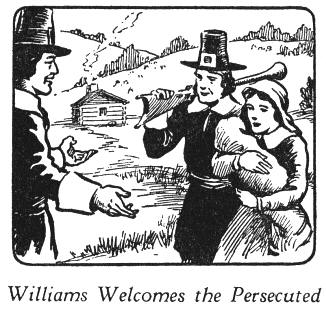
Roger Williams Dreams of Founding an Asylum for the Oppressed
While the sentence of banishment was hanging over Roger Williams’ head, he saw that it was impossible to reform the existing establishments in New England, and that in order to realize his dreams it would be absolutely necessary for him to launch out into the wilderness in virgin territory and establish an asylum for the oppressed of America as well as for the persecuted in Europe. In the providence of God, Sir Henry Vane, Jr., a personal friend of Roger Williams, arrived in Salem just at this critical juncture and visited the home of Mr. Williams. Williams confided to him his contemplated dreams of establishing a new colony–outside the limits of the Massachusetts Bay Colony, as well as beyond the limits of the Plymouth Colony. He was determined to frustrate the sentence of banishment back to England by escaping into the wilds of North America. In the providence of God, and with the aid of his friends, he hoped to work out his own experiment of civil government. Later developments indicate that Sir Henry Vane, Jr., undoubtedly promised him assistance in this contemplated experiment. His eyes turned to the uninhabited territory south of the Plymouth Colony, with which he was on terms of good friendship. He had previously visited the Indian chiefs and had done missionary work among the Narragansett Bay Indian tribes. He was confident that he could purchase land from them for his contemplated settlement. So a little more than three hundred years ago, while the sentence of banishment was waiting to be executed, Roger Williams contemplated the founding of the infant republic of Rhode Island upon the broad principles of civil and religious liberty for the enjoyment and benefit of every man, where there should exist a total separation of church and state and the equality of all religions before the civil law and the bar of justice. His hopes and dreams in due time were fully realized. His little republic became the wonder and admiration of the world and the. home of the oppressed of all lands, and grew so rapidly that the Massachusetts Bay Colony became alarmed, fearing that in a few more years it would outrival the population of the older colony. The Puritans of Massachusetts Bay Colony thought Roger Williams was of the same spirit as they were, and that when he was powerful enough, he would retaliate for the cruel treatment they had accorded him in 1635, when they had banished him from the Bay Colony on the charge of heresy. The governor of Massachusetts, Mr. Endicott, sent two messengers to Roger Williams with a letter inviting him to join his government to the Massachusetts Bay Colony, that they might ever after live in friendly relations. But Roger Williams did not trust the Puritans of Massachusetts, and he sent the following message back to Governor Endicott: "I feel safer down here among the Christian savages along Narragansett Bay than I do among the savage Christians of Massachusetts Bay Colony." One Great Objective Roger Williams, after his banishment, had but one great objective to which he devoted the rest of his life, and that was to establish a government in America that might become the model for future generations, and also to create an asylum for the oppressed and persecuted of every religious faith, not only in America, but also in Europe. He believed that in order for citizens to enjoy the greatest peace and prosperity, the church and state should be entirely divorced and separated in their functions. He believed that truth was its own best defender, and that it needed neither aid from the civil government nor carnal force to advance its tenets. "The armies of truth," he said, "like the armies of the Apocalypse, must have no sword, helmet, breastplate, shield, or horse, but what is spiritual and of a heavenly nature." The Puritans likewise believed in religious liberty, but they thought that this blessing should not be enjoyed by any dissenting sects which were not in agreement with the Puritan faith. In fact, the Puritans fled to America that they might enjoy the blessing of religious freedom in worship which was denied them in England before the Puritan Parliament came into supreme power under Oliver Cromwell. After the Puritans gained the ascendancy in political power in England, and even before that political upheaval, they denied to others the religious liberty which they demanded for themselves. Oliver Cromwell exposed this fault of the Puritans, of both the Presbyterians and the Independents, in a speech on the dissolution of Parliament, when he said: "Is it ingenuous to ask liberty and not give it? What greater hypocrisy for those who were oppressed by the bishop to become the greatest oppressors themselves so soon as their yoke was removed?" This has ever been the case. There never yet has been a sect that has been oppressed, which, when it gained the ascendancy in numbers and strength, did not in turn oppress the weaker dissenting sects through governmental agencies and law. It is human to oppress when entrusted with power, but it is divine to grant liberty to all men, whether they agree with us or not. Roger Williams had caught this divine concept and principle of love, and he practiced it in his life and in his dealings with his fellow men; and the American people did well in rendering him a tardy justice and honor in the tercentenary celebration to his memory. He was in the truest sense the apostle of religious liberty to America in those turbulent and malevolent times when no man was permitted to call his faith and his soul his own. He was one hundred fifty years ahead of his day in thinking and in practicing both civil and religious liberty principles. In fact, his ideals of total separation of church and state have never been completely carried out, even in America, in spite of our boast of religious freedom in this favored land, our government has never divorced itself in its functions from the legal sanctions of religion and religious observances, nor from religious persecution of dissenting sects which are not in agreement with those religious legal sanctions. Full religious liberty has never yet been granted to the individual, in spite of the constitutional guaranties which vouchsafe complete religious liberty and freedom of conscience in religion. Many of the States in the Union still have religious statutes upon their books which have been retained from colonial times when America had a union of church and state, and these religious laws are permitted to override the Federal Constitution and its guaranties of religious liberty to the individual. All that is needed to kindle the flames of religious persecution today is to elect a religious bigot to a civil office, and these un-American laws will be invoked against the nonconformist who dares to assert the supremacy of conscience in religious matters. The more austere and conscientious a person is in his religious convictions, the greater is the danger that he will become a persecutor of those who happen to disagree with him, provided he is entrusted with power. Like Saul the persecutor, this type of person is always actuated by the idea that in persecuting dissenters he is doing God valiant service. The religious legalist, no matter how pious he may be, is never tolerant. Force instead of love is the propelling power of his religion. Everything and everybody must bow to his religious convictions. The dissenter has no right to his convictions, because he cannot be right in the sight of a self-satisfied legalist. Roger Williams was not a legalist in religious matters. He was a dissenter, and he believed that others had the same right to dissent from his views, and that the right of dissent for all should be sacredly protected by law, so that all might stand on an equality before the bar of justice. The pages of history are stained with the blood of millions of martyrs, for the simple reason that both the church and the state failed to recognize that the right to dissent should be sacredly guarded. As soon as Roger Williams arrived in America in 1631, he began to preach absolute liberty of religion for every sect, and for so-called heretics, and even for infidels; and he sensed that this cherished blessing for all men could never be realized without a complete separation of the church from the state. He failed, however, to convince the Puritans of Massachusetts Bay Colony. Having incurred their ill will, he was banished by them because he taught that the "civil magistrate should not punish anyone for the breach of the first four commandments" of the decalogue, or "interfere in matters of religion and conscience," nor should he "constrain anyone to this or that form of religion." Such doctrine, which at present is considered in America as sound doctrine, was then called "damnable heresy." The banishment of Williams made him more determined than ever to plant the seeds of civil and religious liberty in America, and to found an independent government in which all could worship God in harmony with the dictates of their own conscience, in which no one could be molested by the civil magistrate so long as he conducted himself as a good citizen in purely civil matters. He decided to prepare settlements in the New World for all who were religiously oppressed in Europe as well as in America. He made his first appeal to the Independents, or Separatists, then to the Baptists and the Quakers, to come to the plantations of Rhode Island. They came from all lands in large numbers, and were granted perfect freedom of worship for all faiths. In justification of his doctrine of the absolute separation of church and state, Roger Williams said: "The civil sword may make a nation of hypocrites and anti-Christians, but not one Christian." "Christ Jesus, the deepest politician [statesman] that ever was, ... commands a toleration of anti-Christians. "The civil magistrates [are] bound to preserve the bodies of their subjects, not to destroy them for conscience’s sake." "Seducing teachers, either pagan, Jewish, or anti-Christian, may yet be obedient subjects of the civil laws." "Christ’s lilies may flourish in His church, notwithstanding the abundance of weeds in the world permitted." "A national church [is] not instituted by Jesus Christ." "The civil commonweal, and the spiritual commonweal, the church, [are] not inconsistent, though independent the one on the other." "Forcing of men to godliness or God’s worship [is] the greatest cause of the breach of the civil peace." "Masters of families, under the gospel, are not charged to force all under him from their own conscience to his." "Persons may with less sin be forced to marry whom they cannot love, than to worship when they cannot believe." "Christ Jesus never appointed a maintenance of ministers from the unconverted and unbelieving." Roger Williams vehemently opposed what he called "the most deplorable statute in English law," namely, the statute which compelled everybody, without distinction or religious faith, to attend the divine services in his parish every Sunday. In assailing this statute, Williams said: "An unbelieving soul is dead in sin, and to drag an unbeliever from one form of worship to another is the same thing as changing the clothes of a corpse." With equal earnestness he combated the practice of forced contributions for the benefit of ministers of religion. His adversaries asked: "Is not the laborer worthy of his hire?" "Yes," Williams replied, "from them that hire him, from the church." Roger Williams was truly an apostle of religious liberty sent from God to America. The cause of religious liberty in America may still produce great leaders in defense of those fundamental principles, but it will be difficult for any to excel Roger Williams in the purity and logic of his reasoning, in the breadth of conception, and in the sincerity of the advocacy of sound principles in that cause. All lovers of civil and religious liberty who cherish our present heritage of freedom in America as it has been handed down to us by the founding fathers of our Republic, who derived their inspiration from the writings of Roger Williams, did well, in the year of 1936, at the tercentenary celebration, to pay a belated tribute to this great apostle of soul liberty, to whom we are more indebted for our precious heritage of democracy and religious freedom than to any other man, except the Man Christ Jesus, from whom Roger Williams derived his inspiration and opinions concerning man’s proper relationship to God and religion. The Principles of Religious Liberty as Conceived by Roger Williams Roger Williams pioneered the way for the disestablishment of religion and the divorcement of the church from the state in America. The burden of his soul was that all men might be free to worship or not to worship God, as their own consciences dictated. He endeavored to reestablish primitive Christianity in harmony with the teaching and practice of the Author of Christianity. The burden of every sermon he preached, of every book he wrote, and of all his labors of charity, was to reveal the spirit of Christ to men, and lead them back to the true religion. He spoke and wrote of Jesus Christ as the Author of all our liberties and the Deliverer from all our bondages. In appealing to the lawmakers and magistrates of his time to be tolerant toward all religious dissenters, Roger Williams cited the example of his Lord, saying: "Jesus Christ, the deepest politician [statesman] that ever was, .. . commands a toleration of anti-Christians." He quoted Christ as saying: "If any man hear My words, and believe not, I judge him not: for I came not to judge [condemn] the world, but to save the world.... The word that I have spoken, the same shall judge him in the last day." He showed that in spiritual matters God, and not man, was the judge in the last day, and therefore no man had a right to punish any man for his offenses against God and religion before the judgment day. The civil magistrates could punish men for civil offenses only -those that had to do with man’s relationships to man. He argued that it frequently happened, and was at all times possible, that "many seducing teachers, either of the paganish, Jewish, Turkish, or anti-Christian religion, may be clear and free from scandalous offences in their life, as also from disobedience to the civil laws of the state." Therefore he contended that so-called heresy should never be punished by the civil magistrate, unless the exercise of that heresy led to the violation of the rights of others, and the individual should not be punished for the heresy, but for the infringement of the rights of others. In Roger Williams’ day, every man’s religion was prescribed by the state, and all had to attend church services on Sunday and give financial support to religion, whether they were members of the state church or whether they made any profession of religion. He vigorously opposed, not only compulsory church attendance on Sunday, and Sunday observance under duress of the civil magistrate, but the compulsory taxation of everybody’ to support religion or the state church. His ideas of a complete separation of church and state and of the free exercise of the conscience of the individual in religious matters were centuries in advance of his time. There is not a country in the world that has yet put into effect all these fundamental principles of a complete separation of church and state. Rhode Island was the only State that did it, and that State did it only as long as Roger Williams was the guiding spirit in its civil affairs. As soon as he relinquished his grip upon state affairs and passed off the stage of action, the State legislature enacted laws of religious intolerance, compelled all people to observe Sunday under the penal codes, and sent so-called heretics into exile. But as long as Roger Williams lived and had a controlling voice in the making of laws and the administration and execution of those laws, no man suffered for conscience’ sake, because there were no religious laws upon the statute books under which he could be prosecuted for his dissenting views in religious matters. There can be no religious persecution when the civil government is neutral upon all religious questions. Roger Williams was so far in advance of the church and state leaders of his time, that to them he seemed a mere dwarf in the distance, but a consummate heretic withal. The church leaders of that day, aside from the Baptists, feared religious toleration and hated religious liberty. In following the teachings and example of John Calvin, who burned Servetus at the stake on a charge of heresy and who advocated the doctrine that "godly princes may lawfully issue edicts for compelling obstinate and rebellious persons to worship the true God and to maintain the unity of the faith," the Calvinists and Puritans did not hesitate to shed the blood of those whom they called heretics. John Cotton not only denounced Roger Williams’ views on religious freedom for the individual, but on democracy as well, saying: "Democracy, I do not conceive that ever God did ordain as a fit government either for church or for commonwealth.... As for monarchy and aristocracy, they are both of them clearly approved and directed in Scripture." Nathaniel Ward, who styled himself a "Lawyer Divine," and drew up the first legal code for Massachusetts Bay Colony, in replying to the argument that it was religious persecution to deprive the individual of his right to liberty of conscience in religious matters, said: "It is an astonishment to think that the brains of men should be parboiled in such impious ignorance." Religious liberty was a perfect stranger, not only in New England, but in every country in Europe and in every Christian denomination except the ‘Baptists. The Protestant Reformers who had begun so nobly to proclaim the gospel of liberty, the absolute supremacy of the word of God, the separation of church and state, a full and unrestricted freedom of conscience for the individual in religious matters, and the noninterference of the state in matters of heresy, soon abandoned this exalted platform, established their own religions by law, and delivered heretics and dissenters to the state to be punished. Roger Williams, of all the great Protestant Reformers, stood alone in the integrity of his position, and finally worked out a concrete example of a free church in a free state, where no citizen was molested for holding and practicing dissenting views in religious matters. Williams never once abandoned his position on the total separation of church and state. Martin Luther, in the beginning of his Reformation work, said: "No one can command or ought to command the soul except God, who alone can show it the way to heaven. It is futile and impossible to command, or by force to compel any man’s belief. Heresy is a spiritual thing, which no iron can hew down, no fire burn, no water drown.... Whenever the temporal power presumes to legislate for the soul, it encroaches." But Luther compromised this principle of religious liberty when he faced an emergency and accepted aid from the state, and when he received the support of the state he robbed the great Reformation movement of the glory and splendor of a great spiritual triumph through Christ and the power of His work. His later writings reveal that he completely abandoned the principle of religious liberty and the doctrine of a separation of church and state. In writing how dissenting preachers should be dealt with, he advised: "Since it is not good that in one parish the people should be exposed to contradictory preaching, he [the magistrate] should order to be silent whatever does not consist with the Scriptures." Luther made his appeal to the civil ruler as the final judge and arbiter of truth, and believed that heretics should be delivered to the civil magistrate for punishment. When the Anabaptists in the lands of the Reformation taught the doctrine of immersion as the proper Scriptural mode of baptism, and proclaimed infant baptism as utterly useless and without divine authority, the great Protestant Reformers applied the whip, the sword, the torch, as well as fines, confiscation of property, and the dungeon cell to these dissenters. When the Protestant sects resorted to the civil authorities to punish heresy, it was merely a case of religious tyranny changing hands under a new religious regime. In writing to Menius and Myconius in 1530, Martin Luther favored applying the sword to the Anabaptists. He said: "I am pleased that you intend to publish a book against the Anabaptists as soon as possible. Since they are not only blasphemous, but also seditious men, let the sword exercise its rights over them, for it is the will of God that he shall have judgment who resisteth the power." Melanchthon, a colaborer with Luther, in a letter to the diet at Hamburg, in 1537, advocated death by the sword to all who professed Anabaptist views. Zwingli, the Swiss Reformer, who perished with the sword, and whose statue in Zurich pictures him with a Bible in his right hand and a sword in his left, persecuted not only the Baptists, but all dissenting sects who disagreed with his views. Even John Robinson, the renowned pastor of the Pilgrims in Holland, who was far more liberal in his views than the Puritans, vigorously defended the use of the magistrate’s power in matters of church discipline "to punish religious actions, he [the magistrate] being the preserver of both tables, and so to punish all breaches of both." Roger Williams took direct issue with both the Puritans and the Pilgrims, and denied the right of the civil magistrate to legislate the first table of the decalogue into civil law or have the civil magistrate punish any of the offenses against God as set forth in the first four commandments of the law of God. It was this doctrine of the intrusion of the power of the civil magistrate into the spiritual realm, which Roger Williams so vigorously opposed, posed, and which he fought single-handed, that caused his banishment and the bitter persecution which he had to endure everywhere in his day. He invited the Baptists as well as the Seventh Day Baptists to come to Rhode Island, where they might enjoy their faith without civil molestation. He finally accepted their faith. He said: "I believe their practice comes nearer the practice of our great founder Jesus Christ than other practices of religion do." When Mr. John Clarke, Mr. Obadiah Holmes, and Mr. Crandall were appointed by the Baptist church of Newport, Rhode Island, to visit an old man of the Baptist persuasion near Lynn, Massachusetts, at his own request, the civil magistrates and Puritan ecclesiastics of the Bay Colony decided it was time to nip the spread and growth of Anabaptistry in the bud. They arrested and imprisoned the three men and sentenced them to be fined or whipped. It is recorded that "they refused to pay the fines, which would be acknowledgment that they were wrong." Someone else paid Clarke’s fine, without his knowledge. Mr. Holmes was whipped so severely that for a long time "he could take no rest except by supporting himself on his knees and elbows." Two of his friends, John Spur and John Hazel, who had expressed their sympathy for Mr. Holmes’ pitiable condition, were arrested and imprisoned. Mr. Clarke, concerning his own trial, said: "At length the governor [John Endicott] stepped up and told us we had denied infant baptism, and being somewhat transported, told me I had deserved death, and said he would not have such trash brought into their jurisdiction." Roger Williams wrote a letter of admonition and Christian rebuke to Governor Endicott, setting forth the great doctrine of liberty of conscience in religious matters—of the equality of all men before the law, and of the "spiritual unlawfulness of persecution for cause of conscience." In his letter to Endicott, he says: "I speak of conscience, to persuasion fixed in the mind and heart of man.... This conscience is found in all mankind, more or less, in Jews, Turks, papists, Protestants, pagans, etc.... 0, how comes it then that I have heard so often, and heard so lately, and heard so much, that he that speaks so tenderly for his own, hath yet so little respect, mercy, or pity to the like conscientious persuasions of other men? Are all the thousands of millions of millions of consciences, at home and abroad, fuel only for a prison, for a whip, for a stake, for a gallows? Are no consciences to breathe the air but such as suit and sample his?" Again he affirmed in his letter to Endicott his well-known position, denying the right of the "magistrates dealing in matters of conscience and religion, as also of persecuting and hunting any for any matter merely spiritual and religious." He sums up the essence of his argument on liberty of conscience in the closing paragraph: "Sir, I must be humbly bold to say that ‘tis impossible for any man or men to maintain their Christ by their sword, and to worship a true-Christ, to fight against all consciences opposed to theirs, and not to fight against God in some of them and to hunt after the precious life of the true Lord Jesus Christ.... 0, remember once again (as I began), and I humbly desire to remember with you, that every gray hair now on both of our heads, is a Boanerges, a Son of Thunder, and a warning piece to prepare us for the weighing of our last anchors, and to be gone from hence as if we had never been." Roger Williams had advanced so far in "the life of love" which he advocated, and ascended so high upon the pedestal of "soul liberty" and civil and religious freedom in matters of conscience and religion, that he encountered an impossible task to lift up the church-and-state leaders to his level. But the torch of liberty which he held aloft and which shone so brightly in Rhode Island in his day was not entirely extinguished after his death. The first Baptist church of Providence of which he was the first pastor, still voiced the message of Roger Williams, of freedom of the conscience of the individual and of the separation of church and state. The Baptists carried that message to Virginia, where they suffered much persecution; and Thomas Jefferson and James Madison became their attorneys and the defenders and champions of their cause for the disestablishment of religion. The ideas of Roger Williams found a rebirth in these two American champions of civil and religious liberty, and Thomas Jefferson gave expression to them in the Declaration of Independence, and James Madison in the Constitution of the United States.
|