|
2. A Brief Biographical Sketch of Roger Williams
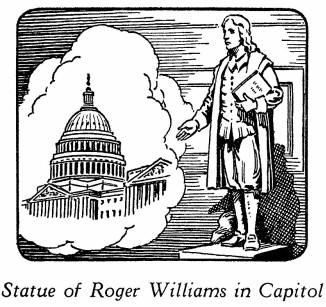
For many years we have commemorated and extolled the life and work of Roger Williams in the founding of Rhode Island more than three hundred years ago, in 1636, when “he lived and dreamed in a future he was not to see, impatient to bring to men a heaven they were unready for,” and it will no doubt be of interest to all lovers of liberty who are anxious to promote the future welfare and happiness of the human race to peruse a brief sketch of the life of this unique and inimitable character––the one original thinker of New England three centuries ago. Cotton Mather correctly called Roger Williams “the first rebel against the divine church order established in the wilderness.” Indeed, says Parrington, “he was very much more than that; he was a rebel against all the stupidities that interposed a barrier betwixt men and the fellowship of their dreams.” Roger Williams was a rebel from his youth against everything that fettered the conscience. In writing of his childhood experiences to Governor Winthrop after his early conversion to the tenets of the Puritan faith, he says, “Myself but a child in everything, though in Christ called and persecuted even in and out of my father’s house these twenty years.” He dared to oppose his parents in religious matters. They stood high in the political, social, and religious order of that day, and to rebel in religious matters against the authority of a parent or of the state church, was no light matter in those times. A nonconformist, or Puritan, under James I, was severely persecuted. Many of the Puritan sect were burned at the stake in Smithfield at the time when young Williams was converted to that faith. His parents lived just a few doors beyond Newgate Prison, or the Smithfield plaza, where the so-called heretics were burned, and the parents’ anxiety for young Roger led them to employ strenuous methods to change his mind back to the state religion, but it was of no avail. All their parental entreaties and harsh methods failed to turn “the erring child from his dissenting ways.” When they entreated him to “believe as the church believes,” the young Puritan, newly converted, replied: “The truth is, ... the Father of light and mercies hath touched my soul with a love to Himself, to His only-begotten and true Lord Jesus, and to His Holy Scriptures.” Such an argument was unanswerable, and that was the kind of argument which characterized all of Roger Williams’ answers to his adversaries. All through his life he met opposition, for he was in advance of the times. He wrote to Mr. John Whipple, Jr., in 1669: “I have been used to bear censures and reproaches for truth’s sake, for reproving and witnessing against the works of darkness above these fifty years.” But the censure, the reproach, and the threats of parents, of friends, of the authorities of the state church, could not dampen the courage or break the spirit of young Roger Williams. In his old age he was as fearless and daring as he had been in his youth for the cause of truth and religious liberty. The year prior to his conversion to the Puritan faith, a certain prominent legate had been burned at the stake at Smithfield, and evidently this event made a deep impression on young Roger’s mind, and led him to investigate the Puritan faith more fully which resulted in his conversion. On his mother’s side, Roger Williams was connected with the prominent Pemberton family, which rose to great political influence in England after the Reformation. These family connections brought him into a prominent social and political environment among the gentility at the opening of the seventeenth century. It was these connections which gained him special political favors and advantages later in life, relative to the establishment of his republic in the New World as an independent territory for his new experiment in government. Roger Williams grew up in a stimulating intellectual environment, with many colorful contrasts. During his boyhood and early manhood, Shakespeare finished his greatest works and died. Lord Bacon revised his essays, from which Williams quoted profusely in his defense of religious liberty principles. He was a student under Sir Edward Coke, the eminent English jurist who defied the royal authority and wrote the “Institutes,” now a classic in common law and a defense of the rights of the people. In his early teens he joined the religious protest of the Puritans against the established church-and-state order, and he chose the political faith of John Eliot and Sir Edward Coke. Because of Roger’s skill in shorthand and his training in legal procedure in the courts of England, Sir Edward Coke chose him as his secretary to take notes of the proceedings in the Star Chamber and to take down his legal opinions and speeches. Young Williams must have been an expert stenographer, for Mrs. Anne Sadlier, daughter of Sir Edward Coke, recorded on the back of a letter from Williams in 1652: “This Roger Williams, when he was a youth, would, in shorthand, take sermons and speeches in the Star Chamber and present them to my dear father. He, seeing so hopeful a youth, took such a liking to him that he sent him to Sutton’s Hospital (Charter House), and he was the second that was placed there; full little did he think that he would have proved such a rebel to God, the king, and his country.” But Sir Edward Coke, chief justice of the King’s Bench, the foremost authority in English law at that time, dared in points of law to withstand Queen Elizabeth and King James when he defended the sovereignty of Parliament and the rights of the people under the common law against the claims of the sovereigns of England. While taking down the speeches of Chief Justice Coke, Williams acquired a fuller understanding of the principles of law and government and the rights of the people and of Parliament, which he applied practically in the building of his model republic in the New World. That he imbibed many of his liberal ideals from Coke, Roger Williams fully acknowledged when he wrote to Mrs. Anne Sadlier in 1652, and paid the highest respect to those sterling qualities which he admired in her father, saying: “My much-honored friend, that man of honor and wisdom and piety, your dear father, was often pleased to call me his son; and truly it was as bitter as death ... to me, when I rode past Windsor Way to take ship at Bristow and saw Stoke House where the blessed man was. . . . But how many thousand times since have I had honorable and precious remembrance of his person and the life, the writings, the speeches, and the examples of that glorious light. And I may truly say that besides my natural inclination to study and activity, his example, instruction, and encouragement have spurred me on to a more than ordinary industrious and patient course in my whole course hitherto.... What I have done and suffered,–and I hope for the truth of God.... you may acknowledge some beams of His holy wisdom and goodness, who hath not suffered all your own and your dear father’s smiles to have been lost upon so poor and despicable an object.... I hope for God, that, as your honorable father was wont to say, he that shall harrow what I have sown must rise early.” The “much-honored friend,” Lord Coke, nominated Roger Williams for a scholarship to the Charter House in 1621, when he was eighteen years old. Later on, he won an appointment to Cambridge University. In the chapel cloister of the Charter House is a memorial to Roger Williams, and in the Hall of Fame in the Capitol building, Washington, D.C., is a marble statue of Roger Williams holding in his hands a Bible upon which is carved: “The Apostle of Soul Liberty.” In Geneva, Switzerland, in the midst of the statues of the great Reformers of the Reformation and the Renaissance, stands in bold relief the statue of Roger Williams as the great reformer, leading all reformers of the reformation in America. At Cambridge University, in 1623, when he was twenty years of age, Roger Williams took up the religious and social protests of the Puritans and reformers and under the able leadership of Lord Edward Coke, who was High Steward of Cambridge University, and of Sir John Eliot, joined the party opposing Bishop Laud’s church policy and the followers of the king. In 1627 Williams received his degree of A.B. from Cambridge, after which he began his studies more specifically for the ministry. His religious studies turned him against the state church, and he left Cambridge in 1629, after taking two years of postgraduate work, discontented with the political and religious atmosphere of the university under the dominating zeal of Bishop William Laud. Sir Edward Coke and other prominent friends endeavored to secure him a position which would afford him a good living. But a “tender conscience,” said Williams, “kept me from honor and preferment. Besides many former offers and that late New England call, I have since had two several livings proffered to me.” The officials of the Massachusetts Bay Colony proffered him the call from New England to become pastor of the Salem church. Drastic steps were taken in 1630 by King Charles and Bishop Laud to stem the tide of liberalism and to blot out Puritanism and other dissenting sectarianism against the established church. The king resorted to physical torture and disfigurement, fines, imprisonment, and whippings of all ardent dissenters. King James had already sent Lord Edward Coke with Pym and Selden to the London Tower, for writing and supporting the protestation against political Catholicism, Arminianism, and the divine right of the king. Many persons fled to Holland for safety, but Roger Williams and other leading Puritans fled to the American wilderness. Mr. Williams had written his “Dissent” against Bishop Laud’s formal service of the Book of Common Prayer, and the bishop was seeking his apprehension and pursued him out of the land. He decided to accept the late New England call. His arrival in Boston on February 5, 1631, marked the beginning of a famous episode in American history. A FABLE FOR CRITICS And I honor the man who is willing to sink Half his present repute for the freedom to think, And when he has thought, be his cause strong or weak, Will risk t’other half for the freedom to speak, Caring nought for what vengeance the mob has in store, Let the mob be the upper ten thousand or lower. –James Russell Lowell. A Brief Biographical Sketch of Roger Williams For many years we have commemorated and extolled the life and work of Roger Williams in the founding of Rhode Island more than three hundred years ago, in 1636, when “he lived and dreamed in a future he was not to see, impatient to bring to men a heaven they were unready for,” and it will no doubt be of interest to all lovers of liberty who are anxious to promote the future welfare and happiness of the human race to peruse a brief sketch of the life of this unique and inimitable character––the one original thinker of New England three centuries ago. Cotton Mather correctly called Roger Williams “the first rebel against the divine church order established in the wilderness.” Indeed, says Parrington, “he was very much more than that; he was a rebel against all the stupidities that interposed a barrier betwixt men and the fellowship of their dreams.” Roger Williams was a rebel from his youth against everything that fettered the conscience. In writing of his childhood experiences to Governor Winthrop after his early conversion to the tenets of the Puritan faith, he says, “Myself but a child in everything, though in Christ called and persecuted even in and out of my father’s house these twenty years.” He dared to oppose his parents in religious matters. They stood high in the political, social, and religious order of that day, and to rebel in religious matters against the authority of a parent or of the state church, was no light matter in those times. A nonconformist, or Puritan, under James I, was severely persecuted. Many of the Puritan sect were burned at the stake in Smithfield at the time when young Williams was converted to that faith. His parents lived just a few doors beyond Newgate Prison, or the Smithfield plaza, where the so-called heretics were burned, and the parents’ anxiety for young Roger led them to employ strenuous methods to change his mind back to the state religion, but it was of no avail. All their parental entreaties and harsh methods failed to turn “the erring child from his dissenting ways.” When they entreated him to “believe as the church believes,” the young Puritan, newly converted, replied: “The truth is, ... the Father of light and mercies hath touched my soul with a love to Himself, to His only-begotten and true Lord Jesus, and to His Holy Scriptures.” Such an argument was unanswerable, and that was the kind of argument which characterized all of Roger Williams’ answers to his adversaries. All through his life he met opposition, for he was in advance of the times. He wrote to Mr. John Whipple, Jr., in 1669: “I have been used to bear censures and reproaches for truth’s sake, for reproving and witnessing against the works of darkness above these fifty years.” But the censure, the reproach, and the threats of parents, of friends, of the authorities of the state church, could not dampen the courage or break the spirit of young Roger Williams. In his old age he was as fearless and daring as he had been in his youth for the cause of truth and religious liberty. The year prior to his conversion to the Puritan faith, a certain prominent legate had been burned at the stake at Smithfield, and evidently this event made a deep impression on young Roger’s mind, and led him to investigate the Puritan faith more fully which resulted in his conversion. On his mother’s side, Roger Williams was connected with the prominent Pemberton family, which rose to great political influence in England after the Reformation. These family connections brought him into a prominent social and political environment among the gentility at the opening of the seventeenth century. It was these connections which gained him special political favors and advantages later in life, relative to the establishment of his republic in the New World as an independent territory for his new experiment in government. Roger Williams grew up in a stimulating intellectual environment, with many colorful contrasts. During his boyhood and early manhood, Shakespeare finished his greatest works and died. Lord Bacon revised his essays, from which Williams quoted profusely in his defense of religious liberty principles. He was a student under Sir Edward Coke, the eminent English jurist who defied the royal authority and wrote the “Institutes,” now a classic in common law and a defense of the rights of the people. In his early teens he joined the religious protest of the Puritans against the established church-and-state order, and he chose the political faith of John Eliot and Sir Edward Coke. Because of Roger’s skill in shorthand and his training in legal procedure in the courts of England, Sir Edward Coke chose him as his secretary to take notes of the proceedings in the Star Chamber and to take down his legal opinions and speeches. Young Williams must have been an expert stenographer, for Mrs. Anne Sadlier, daughter of Sir Edward Coke, recorded on the back of a letter from Williams in 1652: “This Roger Williams, when he was a youth, would, in shorthand, take sermons and speeches in the Star Chamber and present them to my dear father. He, seeing so hopeful a youth, took such a liking to him that he sent him to Sutton’s Hospital (Charter House), and he was the second that was placed there; full little did he think that he would have proved such a rebel to God, the king, and his country.” But Sir Edward Coke, chief justice of the King’s Bench, the foremost authority in English law at that time, dared in points of law to withstand Queen Elizabeth and King James when he defended the sovereignty of Parliament and the rights of the people under the common law against the claims of the sovereigns of England. While taking down the speeches of Chief Justice Coke, Williams acquired a fuller understanding of the principles of law and government and the rights of the people and of Parliament, which he applied practically in the building of his model republic in the New World. That he imbibed many of his liberal ideals from Coke, Roger Williams fully acknowledged when he wrote to Mrs. Anne Sadlier in 1652, and paid the highest respect to those sterling qualities which he admired in her father, saying: “My much-honored friend, that man of honor and wisdom and piety, your dear father, was often pleased to call me his son; and truly it was as bitter as death ... to me, when I rode past Windsor Way to take ship at Bristow and saw Stoke House where the blessed man was. . . . But how many thousand times since have I had honorable and precious remembrance of his person and the life, the writings, the speeches, and the examples of that glorious light. And I may truly say that besides my natural inclination to study and activity, his example, instruction, and encouragement have spurred me on to a more than ordinary industrious and patient course in my whole course hitherto.... What I have done and suffered,–and I hope for the truth of God.... you may acknowledge some beams of His holy wisdom and goodness, who hath not suffered all your own and your dear father’s smiles to have been lost upon so poor and despicable an object.... I hope for God, that, as your honorable father was wont to say, he that shall harrow what I have sown must rise early.” The “much-honored friend,” Lord Coke, nominated Roger Williams for a scholarship to the Charter House in 1621, when he was eighteen years old. Later on, he won an appointment to Cambridge University. In the chapel cloister of the Charter House is a memorial to Roger Williams, and in the Hall of Fame in the Capitol building, Washington, D.C., is a marble statue of Roger Williams holding in his hands a Bible upon which is carved: “The Apostle of Soul Liberty.” In Geneva, Switzerland, in the midst of the statues of the great Reformers of the Reformation and the Renaissance, stands in bold relief the statue of Roger Williams as the great reformer, leading all reformers of the reformation in America. At Cambridge University, in 1623, when he was twenty years of age, Roger Williams took up the religious and social protests of the Puritans and reformers and under the able leadership of Lord Edward Coke, who was High Steward of Cambridge University, and of Sir John Eliot, joined the party opposing Bishop Laud’s church policy and the followers of the king. In 1627 Williams received his degree of A.B. from Cambridge, after which he began his studies more specifically for the ministry. His religious studies turned him against the state church, and he left Cambridge in 1629, after taking two years of postgraduate work, discontented with the political and religious atmosphere of the university under the dominating zeal of Bishop William Laud. Sir Edward Coke and other prominent friends endeavored to secure him a position which would afford him a good living. But a “tender conscience,” said Williams, “kept me from honor and preferment. Besides many former offers and that late New England call, I have since had two several livings proffered to me.” The officials of the Massachusetts Bay Colony proffered him the call from New England to become pastor of the Salem church. Drastic steps were taken in 1630 by King Charles and Bishop Laud to stem the tide of liberalism and to blot out Puritanism and other dissenting sectarianism against the established church. The king resorted to physical torture and disfigurement, fines, imprisonment, and whippings of all ardent dissenters. King James had already sent Lord Edward Coke with Pym and Selden to the London Tower, for writing and supporting the protestation against political Catholicism, Arminianism, and the divine right of the king. Many persons fled to Holland for safety, but Roger Williams and other leading Puritans fled to the American wilderness. Mr. Williams had written his “Dissent” against Bishop Laud’s formal service of the Book of Common Prayer, and the bishop was seeking his apprehension and pursued him out of the land. He decided to accept the late New England call. His arrival in Boston on February 5, 1631, marked the beginning of a famous episode in American history. A FABLE FOR CRITICS
And I honor the man who is willing to
sink –James Russell Lowell.
|